


News
World Youth Day - The Official Program
(posted 19Sept05) (posted Sept05) (posted May05) Commemorating 750 years since the death of St Clare (posted 3Apr05) Celebrating 120 years in Australia (posted 3Apr05) A Lamp Lit...History of the Poor Clares Waverley Australia 1883 -2004 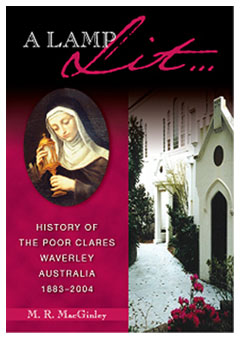
The history of the Poor Clares, Waverley, which is being told for the first time since their arrival in 1883! Available from 2 October 2005 or Poor Clares
New MonasteryPoor Clare 
Pope BenedictPoor Clares Rejoice - Habemus Papam 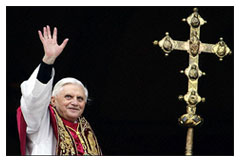
Dear brothers and sisters, After the Great Pope John Paul II, the cardinals have elected me, a simple, humble worker in the Lord's vineyard. I am comforted by the fact that the Lord knows how to work and act even with insufficient instruments. And above all, I entrust myself to your prayers. With the joy of the risen Lord and confidence in his constant help, we will go forward. The Lord will help us and Mary his most holy mother will be alongside us. Thankyou.
Commemorating 750 years since the death of St Clare2003 commemorates the 750th year since the death of St Clare. Below is a timeline beginning with the death of St Clare, her canonisation and all the events surrounding the finding of her body and the building of her tomb. 1253August 11 Clare enters into the fullness of Eternal Life. As her life drew to a close she composed her “canticle” and blessed God for having accomplished in her “His holy workings”. Go in peace, because you will have a good escort. The One who created you has made you holy. The One who created you has infused the Holy Spirit in you and then guarded you as a mother does her little child. May you be blessed, O Lord, You who have created my soul” (Process XI, 3). August 12 With the Pope presiding, the funeral coincided with the solemn translation of Clare’s body, under armed escort, to the church of San Giorgio where the body of Francis had lain from 1226 until 1230 when it was translated to the Basilica built in his honour. October 1 Barely 50 days after Clare’s death the Sisters opened negotiations to exchange San Damiano for San Giorgio. The matter was not that simple. It would be another 10 years before they moved up the hill to be with their Mother Clare. October 18 Innocent IV issues the papal bull, Glorious Deus, in which he entrusts Bishop Batholomew of Spoleto with the responsibility of promoting the Cause of Clare’s canonisation. The uniqueness of this document can be seen in its praise of Clare. Documents of this kind are usually quite reserved and objective; yet this one, written two months after the death of Clare, reflects the sentiments of Innocent IV who, according to the Versified Legend of the Virgin Clare, considered celebrating the Liturgy of Virgins in place of that of the Dead for the funeral of Clare. His enthusiasm was shared by the entire Curia. The Bishop of Ostia thought the matter should be treated more maturely so the sad Solemn Mass followed! November 19 Clare’s sister, Agnes, enters Eternal life. The veneration of Agnes began the day after her death. Tradition places the death of Agnes at November 16 yet in the Legend 48 it has that her death occurred ‘a few days after the death of Clare’. The church celebrates her feast on November 19. November 24 Process of Canonisation Begins ~ Bishop Bartholomew along with the archdeacon, Leonardo of Spoleto, Jocobo, the archpriest of Trevi, Friars Leo and Angelo, Brother Mark, chaplain of San Damiano and a notary went to the Monastery and officially interviewed, under oath, 13 sisters who lived with Clare. November 28 Two other sisters were interviewed, one in the infirmary. Sister Benedetta, Abbess of San Damiano, spoke in the name of the entire community and declared the willingness of all the sisters to testify concerning the sanctity of St Clare. The same day the Bishop and his associates proceeded to the centre of Assisi and interviewed those citizens of the city who had known Clare or experienced her intercession. November 29 The officials then interviewed Ioanni di Ventura who testified to one of the miracles that had occurred after Clare’s death. 1255August 15 The Canonisation of St Clare took place in the Cathedral of Anagni. Clare was the first woman who was not of royal blood to be proclaimed a saint for many centuries. She was the first of Francis’ close companions to be raised to the honours of the altar. St Anthony had been canonised in 1231. However, her feast within the Order of Friars Minor was not promulgated until the Chapter of Narbonne in 1260. What was happening with the Brothers that they could not embrace ‘the most faithful follower of Francis’ liturgically? It wasn’t until the Chapter of Lyons in 1272 that every friary library was mandated to have a copy of her Life. September 26 Alexander IV issues the Bull of Canonisation: Clara claris praeclara 1260October 3 Clare’s body is exhumed and transferred to the Basilica of St Clare. 1850August 6 Permission given to excavate for the remains of St Clare. (In 1849, the Abbess, Mother Clare Columba, was not the only interested person intent upon finding the precious body of St Clare. Formal requests from around the world had been addressed to the Congregation of Rites. Francis’ body had been found in 1818. A question was asked: …as the sun has been manifested, is it not necessary that now the moon may be revealed?) August 23 Excavations begin for the coffin of St Clare in the secrecy of the night. August 30 Opening discovered. The tomb was a conical vault constructed by stone with its highest point reaching up to 6 feet. No inscription was found. “Not a medal, not a letter, not an emblem was found inside or outside the coffin placed in the tomb made of stone.” But there the body lay! The body was reduced to bones beneath darkened skin. A wreath of laurel, which the nuns had woven for their mother in the 13th century, was found to be flexible, the leaves still clinging to their stems. Branches of thyme, which had been placed around the precious body, were found to be in a remarkable state of preservation. The head was reclining to the right shoulder, the left arm was leaning on the breast, and the right extended down the side of the body. The body was placed in a casket and venerated by the Poor Clares, ‘a most affecting sight’. September 15-17 A tridium was preached to the jubilant populace of Assisi preparing them for the final recovery of Assisi’s beloved daughter. September 23 Celebration of the formal recovery of the body of St Clare. Feast instituted by Pius IX. September 26-28 Second tridium after which the casket was reopened to proceed with the clothing of the body; a crown of flowers was placed upon the sacred head. The casket now sealed was placed on the high altar for veneration by the faithful. September 29 The body of St Clare is carried first to San Rufino then to visit the Tomb of St Francis. Then it is placed beneath the cross of San Damiano. 1852June 22 ‘Feast of the Vow’ ~ ground is broken for the subterranean Chapel. August 12 Subterranean Chapel to be built around the tomb of St Clare. Cornerstone laid. 1857May 8 Pius IX pays a visit to the Monastery and spends some time in prayer before the temporary tomb. Those were critical times for the Church and once again a pontiff was strengthened and consoled by the presence of Clare. 1860Work comes to an abrupt halt with renewal of revolutionary movement. 1864May 10 Sisters become apprehensive about the preservation of the body of St Clare. An expert is consulted. The large bones are enclosed in metallic netting; the partially preserved head is covered with a mask of finer netting through which the darkened skin is visible. The body reclothed in a tunic of ashen coloured wool and is placed in a larger casket to await the solemn transferral to the new chapel. 1871More peaceful times had come to Assisi. The convocation of Vatican I in Rome occasioned many pilgrimages to Assisi and generous financial assistance had been given to the nuns. 1872September 29 22 years after the first solemn exposition, St Clare is carried once more in procession to San Rufino and the Tomb of St Francis. September 30 - October 2 A tridium is celebrated once again. October 3 The procession of September 29 is repeated. It is the anniversary of the first deposition as in 1260. Monsignor Pecci, who as future Pope Leo XIII, seemed to have the same attraction for St Clare as his predecessors, celebrates the Solemn Mass. After the Mass the Te Deum is intoned. The body of St Clare is then carried to its final resting place close to the tomb where she had lain hidden for 6 hundred years. This time she is laid in a beautiful crystal casket, clothed in a habit made by the Poor Clares of Marseilles. The “Candle of Umbria” was visible again to give light to the whole household of the Church. 1953July 7-10 The Seventh Centenary of the Death of St Clare is celebrated. A partial inspection was carried out and the habit was exchanged for the tunic of the Poor Clares. A true recognition of the bones was not undertaken for fear that further handling would harm them. 1986November 17 Once again the body of St Clare is taken from its urn. November 18 For many years the nuns had been thinking of renewing the urn, which was in poor condition, but the decision to subject the remains to a conservation treatment was only recent. The treatment would take 9 months. 1987April 11 On the vigil of Palm Sunday the Sisters processionally accompanied the blessed remains to the tiny choir in the crypt. A solemn transitus takes place. The hallowed relics were then inserted in the resin figure of St Clare, clothed with the humble tunic of the Poor Clares, which lies on a rough oaken board inside the urn of small pilasters in Subasian stone and it is as thus, from April 12 1987 onwards, she appears to the numerous pilgrims, who descend into the crypt to venerate the little plant of our Father St Francis. Inside the enclosure those poor loved relics remain visible to the sisters through an opening left in the image-reliquary. Still today her fragrance fills the whole church. Her life continues to sing the strong, sweet melody of the Gospel………
Celebrating 120 years in Australia120th Anniversary Celebrations “It was wonderful day for me because there was such a large gathering of family, friends and some ex-students,” says Sr Joanne. “The Mass was a joyful occasion, full of deep gratitude for what the order has achieved in Australia”. Sr Joanne Fitzsimions says it was through “the loving and natural goodness of the Poor Clares sisters that God gave her the call to enter religious life.” “I was taught by the sisters at St Clare's College at Waverley and they had a dramatic influence on my life,” she says. “They were very God-centered and I found I could be myself around them. “I would come alive in their presence, which is what attracted me to join the order.” She was 17 when she joined the Poor Clares at Waverley in 1962. Reflecting on the 41 years since, Sr Joanne says “It's a special privilege” to be part of the order. “I have no regrets in joining the order at such a young age,” she says. “I had to contend with the continual struggle in deepening my life and, as I was young, I had to grow into adulthood. “I have been able to follow God being a part of a special group of women.” “The sisters have a gentle and loving nature about them, which I think rubs off on students and other people,” says Sr Joanne. “Students have told me they feel a sense of warmth arid comfort being around the sisters. The sisters try to make the students feel special which, I feel, brings the best out in them.”
|
||
Site design by Studio Baires
|

|